
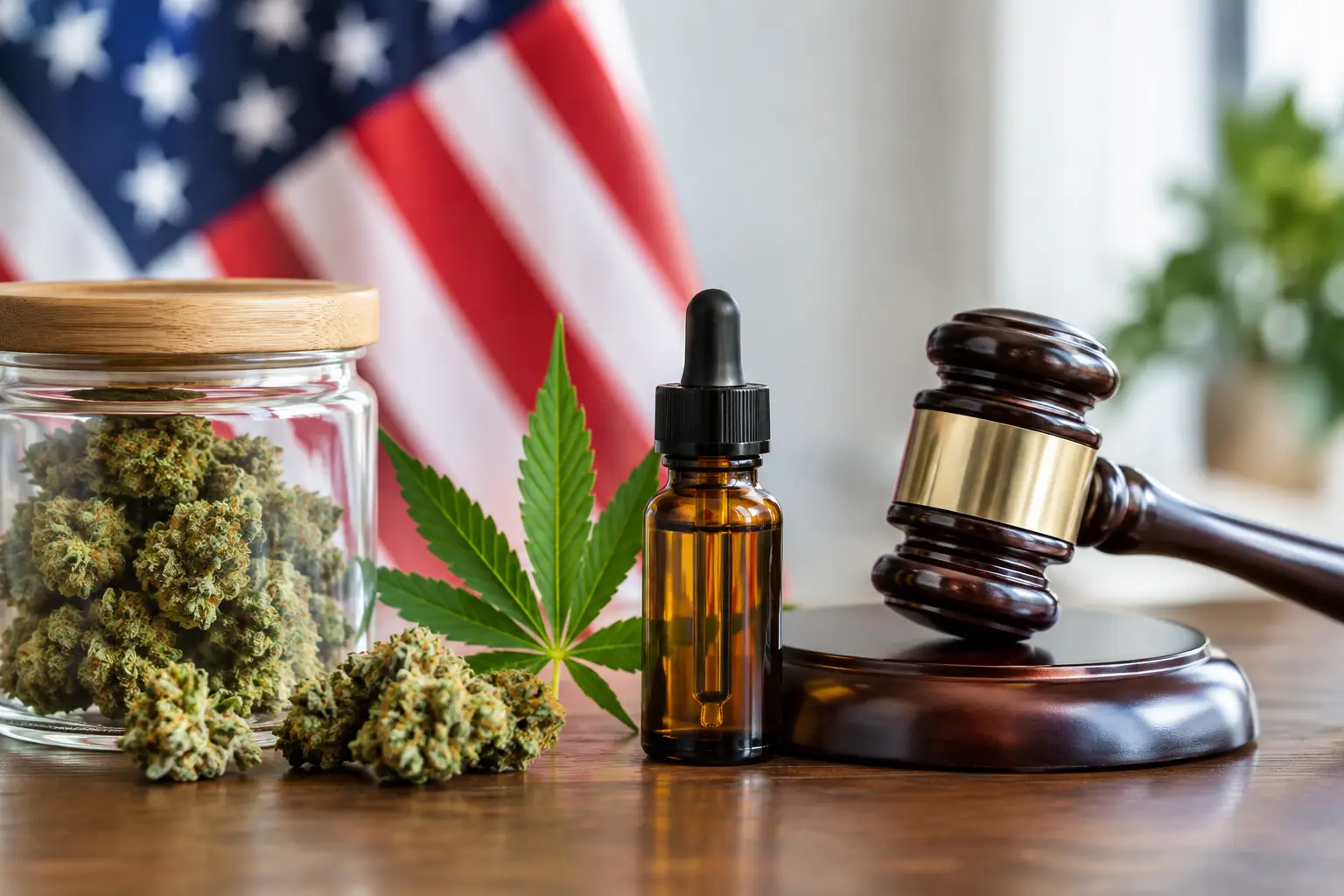
A jar labeled “hemp-derived THCA” can look nearly identical to dispensary cannabis flower, smell the same, and produce similar effects after it is heated. That resemblance is exactly why the question, is THCA legal federally, does not have a simple yes-or-no answer.
Federal law draws a line based largely on a plant or product’s delta-9 THC concentration, not on whether a product may become intoxicating after smoking, vaping, or baking. THCA sits awkwardly on that line. It is a naturally occurring cannabinoid that can convert into delta-9 THC when heated, yet it is not itself delta-9 THC in its raw form.
For consumers, retailers, and anyone crossing state lines, the practical answer is this: some THCA products may qualify as federally lawful hemp under a narrow reading of the federal hemp definition, but high-THCA flower remains legally unsettled and can still create serious state-law and enforcement risks.
Is THCA legal federally under the Farm Bill?
The federal starting point is the 2018 Agriculture Improvement Act, commonly called the 2018 Farm Bill. It removed “hemp” from the federal Controlled Substances Act. Hemp is defined as Cannabis sativa L. and its derivatives, extracts, and cannabinoids with a delta-9 THC concentration of no more than 0.3% on a dry-weight basis.
That wording matters. The statute specifically measures delta-9 THC. It does not set a separate numerical cap for THCA in finished retail products. This gave rise to the market for high-THCA hemp flower: flower that tests below 0.3% delta-9 THC before heating but contains substantially more THCA.
So, under the argument used by many hemp businesses, a product that stays below the federal delta-9 THC limit can qualify as hemp even if its THCA content is high. But that is not the same thing as a blanket federal approval of every product marketed as THCA.
Federal legality can turn on details that are easy to miss: where the cannabinoid came from, how the crop was tested, whether it was produced under an approved hemp program, and whether the product actually meets its label claim. A product derived from federally illegal marijuana does not become lawful hemp simply because a package highlights THCA rather than delta-9 THC.
Why THCA flower creates so much confusion
THCA is short for tetrahydrocannabinolic acid. In fresh cannabis, it is the acidic precursor to delta-9 THC. Raw THCA is generally not associated with the same intoxicating effects as delta-9 THC.
Heat changes the equation. Through decarboxylation, THCA loses a carboxyl group and converts into delta-9 THC. Smoking and vaping do this quickly. Oven heat can do it too, which is why raw flower and heated flower can have very different effects.
That chemistry produces a legal mismatch. A pre-roll can test below 0.3% delta-9 THC before it is lit, while its THCA content indicates that it may produce much more delta-9 THC after combustion. Federal hemp law does not clearly resolve every consequence of that transformation for consumer products.
This is also why a label showing “0.28% delta-9 THC” is not enough to tell the whole story. Look for the certificate of analysis, often called a COA, and distinguish between delta-9 THC and total THC. A total THC calculation generally accounts for THCA’s potential conversion to delta-9 THC.
Total THC testing is a major federal complication
The U.S. Department of Agriculture’s hemp production rules require licensed hemp producers to use a total THC measurement for regulatory compliance. In plain English, producers cannot ignore THCA when determining whether harvested cannabis exceeds the legal hemp threshold.
A common formula is:
Total THC = delta-9 THC + (THCA × 0.877)
The 0.877 factor reflects the mass lost when THCA converts to delta-9 THC. Under this approach, flower with substantial THCA will usually exceed the 0.3% total THC threshold, even if its existing delta-9 THC level is low.
This has led to an apparent contradiction in the marketplace. USDA production rules treat THCA as relevant to hemp compliance at the crop-testing stage. Meanwhile, the statutory definition of hemp references delta-9 THC concentration, and retailers may rely on that narrower language when selling finished products.
That gap is not a consumer loophole you can safely rely on. It is a contested regulatory issue. Courts, agencies, Congress, and state legislatures can interpret or change the rules, and the legal treatment may differ depending on the facts of a particular product.
Does the Controlled Substances Act apply to THCA?
The Controlled Substances Act still lists marijuana and tetrahydrocannabinols as controlled substances, subject to exceptions that include federally defined hemp. The source of THCA matters greatly.
THCA extracted from marijuana remains tied to federally illegal marijuana under current federal law, even if a state permits adult-use or medical cannabis. Hemp-derived cannabinoids may fall outside federal controlled-substance restrictions if they meet the statutory hemp definition and were produced lawfully.
Synthetic or chemically converted cannabinoids can raise separate questions as well. “THCA” is not a universal legal shield. Product origin, manufacturing method, testing documentation, and THC concentration all matter.
The Food and Drug Administration adds another layer. Federal hemp status does not automatically mean a product can legally be marketed in every format. Cannabis-derived compounds in foods, dietary supplements, therapeutic products, and products making disease claims can implicate FDA rules. A package claiming to treat anxiety, pain, cancer, or insomnia deserves extra skepticism, especially when it offers no meaningful evidence or quality documentation.
State law can be stricter than federal law
Even where a seller believes a THCA product meets the federal hemp definition, state law may prohibit or restrict it. Some states use total THC standards for hemp products. Others regulate intoxicating hemp products through age limits, potency caps, licensing rules, testing requirements, or bans. Some treat high-THCA flower much like marijuana.
That means a product sold openly in one state may be restricted, seized, or treated as illegal cannabis in another. The federal hemp definition does not override every state restriction on possession, sale, manufacture, or shipment.
Travel is particularly risky. Do not assume that an online order, a hemp label, or a lab report makes a product safe to carry across state lines. Airports, local police, and state regulators do not all approach high-THCA flower the same way, and the flower itself can be difficult to distinguish from marijuana without laboratory testing.
For adults 21 and older, the practical move is to check current law where you live, where you are buying, and where you plan to travel. State cannabis agencies, agriculture departments, and legislative updates are more useful than a retailer’s broad “legal in all 50 states” claim.
What to check before buying THCA products
A careful consumer should treat THCA labeling as the beginning of research, not the end. Ask whether the product identifies both delta-9 THC and THCA, whether a recent batch-specific COA is available, and whether the report comes from an independent laboratory.
The COA should also include safety screening where applicable. Cannabis flower can carry contaminants such as pesticides, heavy metals, mold, or residual solvents depending on how it was grown and processed. A cannabinoid percentage alone does not establish product quality.
Be wary of vague labels such as “legal THC,” “Farm Bill compliant,” or “lab tested” when no batch number or full report is provided. Also remember that high-THCA flower can be intoxicating once heated. Start low, go slow, avoid driving, keep products away from children and pets, and do not combine cannabis with alcohol or other impairing substances.
Is raw THCA intoxicating?
THCA in its raw form is not generally expected to cause the same intoxicating effects as delta-9 THC. Once heated, however, it can convert into delta-9 THC. The effect of a THCA flower product may therefore resemble conventional cannabis flower more than its pre-use delta-9 number suggests.
Can you mail THCA flower across state lines?
Shipping is a legal risk area, not a guaranteed right. A business may believe its product is federally compliant hemp, but destination-state restrictions and disputes over testing standards still apply. Consumers should not assume interstate shipping proves that possession is lawful where they live.
Will THCA show up on a drug test?
It can. Drug tests commonly look for THC metabolites, not a product’s pre-use legal classification. Heating THCA can create delta-9 THC, and using THCA flower may lead to a positive result. If testing matters for work, probation, athletics, or another reason, the safest choice is to avoid THC-related products.
Federal cannabis policy is moving, but it is not moving in one clean direction. Until Congress or federal agencies provide a clearer rule for high-THCA consumer products, treat a low delta-9 label as one data point rather than a legal guarantee - and make your purchase decisions with current state law, credible lab results, and personal safety in view.