
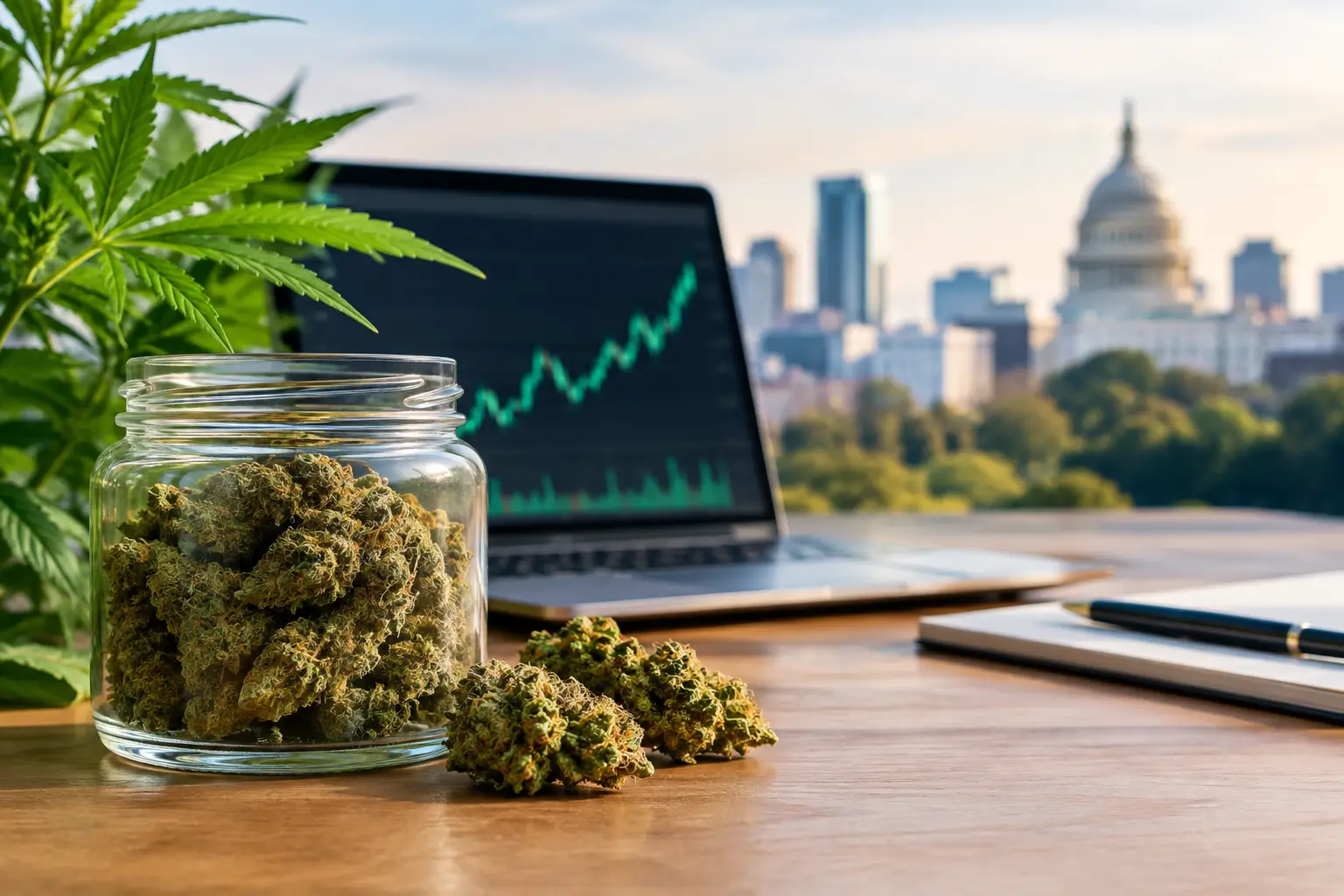
The next phase of the legal cannabis economy is less about opening the first dispensary in a state and more about surviving what comes after. The cannabis industry trends shaping the U.S. market now involve tighter regulation, thinner margins, changing consumer expectations, and a growing divide between products that look legal on a label and products that are clearly regulated by a state program.
For adults 21 and older, these changes affect more than stock-market headlines. They influence what appears on dispensary shelves, how products are tested and labeled, whether a local operator stays open, and how confidently consumers can compare a beverage, vape, edible, or jar of flower.
Cannabis industry trends are becoming more regulatory
Federal policy remains a major source of uncertainty and potential change. Any movement toward rescheduling cannabis could alter the business landscape, particularly around tax treatment, research, and the public perception of medical use. But rescheduling would not automatically create nationwide adult-use legalization, erase state restrictions, or allow cannabis to move freely across state lines.
That distinction matters. Cannabis businesses still operate in separate state markets, each with its own licensing rules, testing requirements, package limits, advertising standards, and social equity provisions. A product that is compliant in Michigan may not be permitted in New York. A marketing claim tolerated in one market could draw scrutiny in another.
The practical trend is a more compliance-heavy industry. Operators are spending more attention on track-and-trace systems, certificates of analysis, child-resistant packaging, inventory controls, and age-gating. For consumers, that can mean clearer labels and safer products. It can also mean higher costs, especially when a state layers taxes, testing fees, and local restrictions onto already expensive operations.
Banking access is improving slowly, not disappearing as a problem
Cannabis banking has become less unusual than it was in the early years of legalization, but access remains uneven. Many businesses can obtain some deposit, payment, or cash-management services, yet they may face elevated fees, limited lending options, and sudden account reviews.
The issue is not simply convenience. Cash-heavy businesses face greater security risks, and limited credit makes it harder for small operators to build inventory, improve facilities, or endure a slow season. Larger multistate operators generally have more resources to manage these constraints, which can deepen the gap between well-funded companies and independent retailers or cultivators.
Hemp-derived THC is forcing a regulatory reset
One of the most consequential market shifts is the rapid growth of intoxicating hemp-derived products. Gummies, drinks, vapes, and other products containing delta-8 THC, delta-10 THC, THCA, or hemp-derived delta-9 THC have reached consumers through smoke shops, convenience stores, online sellers, and, in some places, mainstream retail channels.
Their legal status often turns on technical definitions and dosage calculations rather than the everyday question consumers ask: will this get me high? That gap has created confusion. Some products are made under state cannabis rules with licensed testing, age restrictions, and seed-to-sale tracking. Others are sold outside those systems under hemp frameworks that may have fewer consistent safeguards.
States are responding in different ways. Some are moving intoxicating hemp products into licensed cannabis channels. Others are imposing potency caps, banning certain cannabinoid conversions, requiring testing, or setting 21-plus age limits. A few continue to permit a broad retail market with limited oversight.
For consumers, the label alone is not a guarantee of quality. Potency can vary, and terms such as “hemp-derived” do not tell you whether a product has undergone reliable contaminant testing. The safest approach is to buy from a regulated source when possible, check the cannabinoid amount per serving, and avoid treating a hemp product as automatically mild.
The market is shifting from expansion to discipline
Legal cannabis was once defined by rapid license growth, large cultivation facilities, and aggressive projections. Many markets are now dealing with the harder stage: balancing supply with actual demand.
Wholesale flower prices have fallen sharply in several mature states when cultivation capacity outpaced sales. Lower prices may help consumers, but they can hurt cultivators that carry high energy, labor, rent, and compliance costs. Smaller farms can be especially vulnerable when they cannot negotiate favorable distribution agreements or absorb months of weak pricing.
This has pushed operators toward more disciplined decisions. Expansion plans are being delayed. Companies are reducing product lines that do not sell consistently. Retailers are watching inventory turns closely rather than filling shelves with every new brand. Mergers, asset sales, and closures are a normal part of a maturing market, though consolidation can reduce local choice if it becomes too concentrated.
The strongest businesses are not always the loudest. They tend to understand their state’s regulations, maintain reliable product quality, manage cash carefully, and build a customer base that returns for a clear reason, whether that is value flower, solventless extracts, low-dose beverages, or knowledgeable service.
Consumers are buying for occasions, not just THC percentage
High THC is still a powerful selling point, particularly in flower and vapes, but it is no longer the only story. More consumers are looking for products that fit a particular occasion: a low-dose drink at a social gathering, a fast-acting edible with a predictable serving size, a sleep-focused formula, or a balanced THC-to-CBD product.
That does not mean product claims should be accepted uncritically. Research on cannabis and specific wellness outcomes varies widely in quality, and a terpene-rich label does not guarantee a particular effect for every person. Terpenes are aromatic compounds found in cannabis and many other plants. They may contribute to a product’s aroma and experience, but they are not a medical prescription.
Still, better product segmentation is useful when it is paired with honest information. Consumers benefit from labels that state total THC, THC per serving, other cannabinoids, ingredients, and batch testing details in plain language. A 100-milligram package may be appropriate for an experienced user who portions it carefully, but it can be overwhelming for someone who mistakes the entire package for one serving.
Edibles remain a category where caution matters most. Effects can take one to several hours to fully develop, depending on the product and the person. Start low, go slow, and do not combine cannabis with alcohol or drive after using an intoxicating product.
Testing, freshness, and trust are becoming competitive advantages
As cannabis choices multiply, consumers are asking better questions. When was this flower packaged? What pesticides, heavy metals, microbes, or residual solvents were screened for? Is the lab result tied to the batch in front of me? How was the extract made?
These questions expose an uncomfortable truth: testing rules are not uniform across the country, and laboratory standards can vary even within a state. Regulators have increasingly focused on inaccurate potency results, sample manipulation, and inconsistent contaminant screening. That scrutiny is healthy, but it also shows why a single THC number should not be the sole measure of quality.
Freshness is another underappreciated factor. Cannabis flower can lose aroma and quality when stored poorly or held too long. Proper packaging, sensible storage, and realistic inventory management matter. At home, keep products sealed, away from heat and sunlight, and secured from children and pets. Edibles can be especially easy to mistake for ordinary food.
Research is becoming more useful, but certainty still has limits
Scientific interest in cannabis has expanded, particularly around cannabinoids, pain, sleep, nausea, mental health, and substance-use patterns. Greater research access could improve product standards and clinical understanding over time. Yet consumers should be wary of headlines that turn an early study into a guaranteed health claim.
Cannabis can affect people differently based on dose, route of administration, THC sensitivity, other medications, and personal or family mental health history. Higher-THC products may raise the risk of unpleasant effects such as anxiety, panic, impaired coordination, or confusion, especially for inexperienced users. People who are pregnant or breastfeeding, have certain medical conditions, or take prescription medications should speak with a qualified health professional before using cannabis.
The industry’s credibility will depend partly on whether it can separate promising research from marketing language. Clear evidence ratings, accurate dosing information, and honest limits are more valuable than grand claims.
What to watch next
The next year of cannabis policy and business news will likely be shaped by the pace of federal action, state responses to intoxicating hemp, and whether mature markets can stabilize prices without pushing out local operators. Consumer demand will continue to reward convenience, affordability, and products that feel predictable rather than mysterious.
When evaluating a new cannabis product or a major industry headline, start with the basics: Which law applies? Who regulates it? What does the label actually say? And what evidence supports the claim? Those questions cut through much of the noise and make room for safer, more informed decisions.