
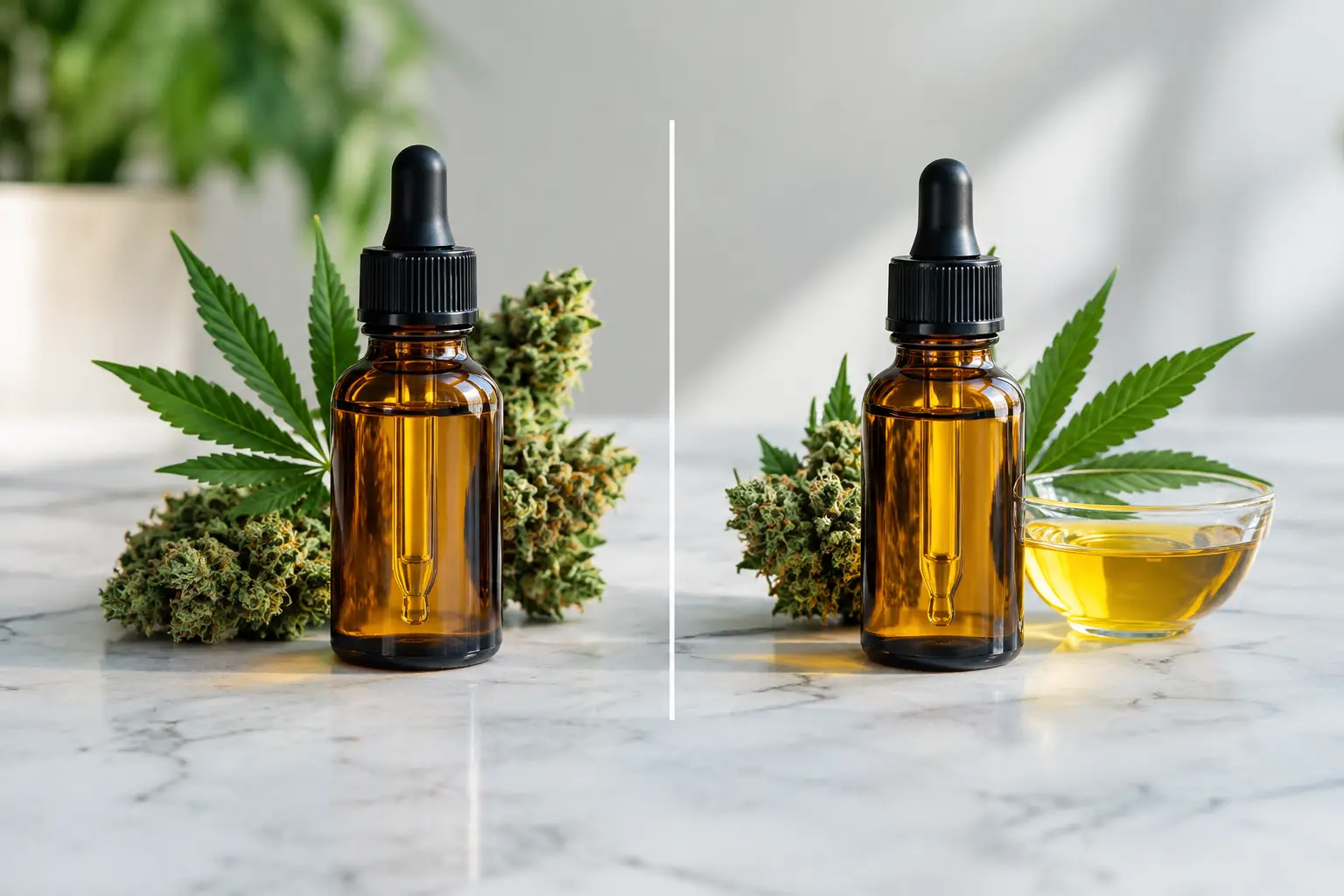
A CBD label can look reassuringly simple until it says full spectrum vs broad spectrum. The distinction matters most for people trying to avoid THC, those subject to workplace drug testing, and anyone who wants a clearer picture of what is actually in an extract. It does not, however, tell you exactly how a product will feel or whether it will help a particular health concern.
These are marketing and formulation terms, not guarantees of quality, safety, or medical benefit. The best way to read them is as a starting point: full spectrum generally retains THC alongside other cannabis compounds, while broad spectrum is generally formulated to remove THC while retaining at least some other compounds from the plant.
Full Spectrum vs Broad Spectrum at a Glance
Full-spectrum extracts contain a range of naturally occurring cannabis plant compounds, including cannabinoids, terpenes, and flavonoids. In hemp-derived products, that usually includes small amounts of delta-9 THC. Under federal law, hemp is defined as cannabis containing no more than 0.3% delta-9 THC by dry weight, but that percentage is not the same as zero THC. A gummy, tincture, or other concentrated product may still deliver a measurable amount per serving.
Broad-spectrum extracts are intended to contain CBD and other non-THC cannabis compounds while having THC removed. The key word is intended. Processing can reduce THC to very low or non-detectable levels, but labels alone cannot confirm the result. A current, product-specific certificate of analysis, often called a COA, is more useful than a front-label claim.
A third category, CBD isolate, contains purified CBD with other cannabinoids and plant compounds largely removed. Isolate is not the same thing as broad spectrum. Broad spectrum is generally chosen by consumers who want more than CBD alone but prefer to avoid THC.
What Full Spectrum Usually Contains
A full-spectrum hemp extract may contain CBD, minor cannabinoids such as CBG or CBC, aromatic terpenes, and trace delta-9 THC. The exact profile varies by plant genetics, harvest conditions, extraction method, and batch. Two products using the same phrase can have very different cannabinoid totals and terpene profiles.
That variability is part of the appeal for some consumers. Cannabis contains hundreds of compounds, and researchers are studying whether combinations of cannabinoids and terpenes affect the body differently than isolated compounds. This is often called the entourage effect.
The idea is plausible as a research question, but it is not a settled promise. Human studies on specific full-spectrum commercial products remain limited, and formulation differences make broad claims difficult to support. A full-spectrum label should not be treated as proof that a product is stronger, more therapeutic, or better for everyone.
THC is the practical trade-off. Even when a hemp product meets the federal 0.3% dry-weight definition, THC can accumulate with frequent use, especially in products with larger serving sizes. Some people may notice impairment, anxiety, or an unwanted psychoactive effect at low doses, while others may not. Individual sensitivity, other medications, food intake, and the product's actual THC level all matter.
What Broad Spectrum Means - and What It Does Not
Broad spectrum is often the more cautious option for adults who want to avoid THC exposure. It can retain CBD plus selected minor cannabinoids and terpenes after THC removal, depending on the manufacturer and the batch. But the term is not a standardized federal assurance that every broad-spectrum product is THC-free.
For that reason, look beyond phrases such as “THC-free.” A reputable COA should identify the product or batch tested, list cannabinoid amounts, and show a result for delta-9 THC. If THC is reported as ND, or non-detectable, check the test's reporting limit when available. “Below the limit of quantification” and “zero” are not always interchangeable statements.
Broad spectrum also does not automatically mean non-intoxicating in every circumstance. Some hemp-derived products contain other intoxicating cannabinoids, including delta-8 THC or chemically converted cannabinoids. Read the full cannabinoid panel, not just the spectrum label. Laws and enforcement around hemp-derived intoxicants vary sharply by state and continue to change.
Drug Testing Changes the Decision
If a positive drug test could affect your job, professional license, athletic eligibility, custody arrangement, or legal situation, neither full spectrum nor broad spectrum offers a risk-free answer. Full-spectrum products present the clearer risk because they contain THC. Broad-spectrum products may lower that risk, but contamination, inaccurate labeling, batch variation, and highly sensitive tests remain concerns.
CBD isolate may be the lower-risk category from a THC-exposure standpoint, but lower risk is not no risk. Supplements and hemp products are not regulated like FDA-approved medications, and product quality varies widely. The only reliable approach for a zero-tolerance testing situation is to avoid cannabis-derived products unless your employer, program, or clinician can provide guidance that fits your circumstances.
How to Compare Products Beyond the Label
The spectrum category is one data point, not a complete buying decision. A useful label should state how much CBD is in each serving and in the entire package. “1,000 mg CBD” can sound substantial, but it may refer to the total contents of a bottle rather than a single dose.
Check the COA's date and batch number. It should align with the item in your hand, not a generic report posted years ago. In addition to cannabinoids, third-party testing can screen for pesticides, heavy metals, residual solvents, and microbial contaminants. Not every report is equally complete, but a brand that provides no batch-level testing leaves major questions unanswered.
It also helps to consider the delivery method. A tincture, capsule, gummy, beverage, vape, and topical do not behave the same way. Edibles can take much longer to produce effects and may last longer than inhaled products. Topicals are generally used on the skin and may have a different exposure profile from products that are swallowed or inhaled. Start with a low amount, particularly when trying an unfamiliar product, and wait before taking more.
Safety, Evidence, and Legal Reality
CBD and other cannabis compounds can interact with prescription medications, including some drugs processed by liver enzymes. That does not mean every combination is dangerous, but it does mean a pharmacist or clinician should be part of the conversation for people taking regular medications, managing a medical condition, pregnant or breastfeeding, or considering CBD for a child.
Evidence is also uneven. The FDA has approved a prescription CBD medication for certain rare seizure disorders, but that does not establish that over-the-counter full-spectrum or broad-spectrum products treat pain, anxiety, sleep problems, or other common concerns. Research in those areas is ongoing, and consumer products can differ substantially from the formulations used in clinical studies.
Federal hemp definitions do not override state rules on sales, possession, age limits, product formats, or intoxicating cannabinoids. Adults 21 and older should check current state and local requirements before purchasing or traveling with a product. Never drive, operate machinery, or mix cannabis products with alcohol if you feel impaired.
The most useful choice is the one that matches your tolerance for THC, your testing risk, and the transparency of the specific product. Full spectrum may fit adults who accept trace THC and want a wider plant-compound profile. Broad spectrum may fit those seeking CBD and other cannabis compounds with an intentional effort to remove THC. In either case, let verified testing and careful dosing carry more weight than a polished label.